
Poveglia
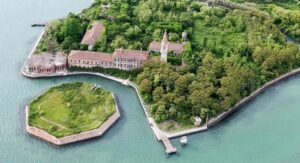
The small island of Poveglia is located in the Venetian Lagoon, between Venice and Lido in northern Italy. Some refer to it as the World’s Most Haunted Island, and with good reason, given the more than one hundred-thousand people who died there in so limited a space.
A QUARANTINE ISLAND
Poveglia was known to initially be populated sometime between the fifth and seventh century. Residents abandoned the island in the fourteenth century due to a war between the maritime states of Genoa and Venice. It wasn’t until the eighteenth century that it was first used as a storage location for Venice, and shortly after, supervised by the Public Health Office, as a sort of Customs checkpoint for arriving ships.
In 1793 two of those ships bore crewmen or passengers suffering from the plague. Venice already had two quarantine islands, but both were full, so Poveglia was repurposed as a plague quarantine site.
Accounts differ regarding the subsequent deaths of tens of thousands of plague victims on Poveglia, but they are equally grim. Some believe that the island itself is made up of fifty percent ash from all of the bodies that were burned. Others claim that, according to research, the bodies were tossed into mass graves known as plague pits. In any case, as they waited to die, many of the victims believed—rightfully so?—that their ghosts were doomed to be trapped on the island for all time.

A creepy hallway in the abandoned asylum.
THE FOG
In the early twentieth century the remaining buildings on Poveglia were converted into an asylum for the mentally ill. Over the ensuing years, many of the inmates reported sightings of the ghosts of plague victims wandering the halls and the grounds. With so many people meeting horrible deaths in so confining a space, how could those claims be questioned?
It is believed that a doctor, who served as director of the asylum, performed gruesome experiments on patients. He later went mad himself, tormented by the ghosts of plague victims. When he saw many of them emerge from a strange fog that had rolled in, he climbed up to the building’s bell tower and jumped to his death. The bell was later removed (the tower remained), but people swore they could hear it tolling for decades afterward.
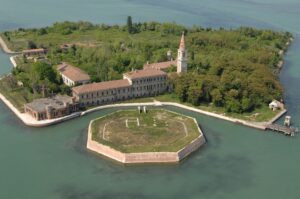 The asylum building finished up its usefulness as a home for indigent elderly people before closing in 1968. Since then, a number of attempts to redevelop Poveglia have failed. The structures that remain include the asylum, the hospital, a church, a covered boat shelter, and the bell tower.
Also still there: the tormented souls of Poveglia, the Ghost Island.