
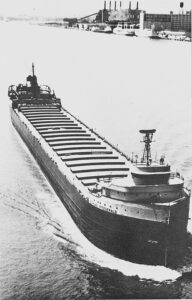
The SS Edmund Fitzgerald.
Five freshwater lakes in North America are known collectively as the Great Lakes. Over the centuries, numerous shipwrecks have accounted for a great number of fatalities. There are no exact figures on the number of wrecks, though estimates have ranged from 6,000 to over 20,000. One number, however, is well-known: the largest death toll on a single vessel plying open water belongs to the ill-fated PS Lady Elgin.
THE GALES OF NOVEMBER
Ask anyone about shipwrecks on the Great Lakes and they will inevitably mention the SS Edmund Fitzgerald, an ore freighter that sank in Lake Superior during a violent storm on November 10th, 1975. Its entire crew of 29 men were lost, their bodies never recovered. The cause of the accident has never been confirmed, despite many dives on the wreck by unmanned and manned submersibles.
Why this one incident among so many thousands? That had to do with the 1976 popular story song, “The Wreck of the Edmund Fitzgerald,” by the late, great Gordon Lightfoot, which he wrote after reading a Newsweek article about the tragedy. The song is still being played on oldies radio to this day.
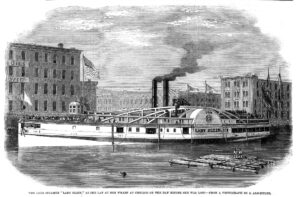
The PS Lady Elgin.
“ONE OF THE GREATEST MARINE HORRORS…”
The PS (paddle steamer) Lady Elgin—a wooden-hulled sidewheel steamship—was built in 1851, and for nearly a decade it plied the waters of Lake Michigan, carrying passengers from Chicago to Milwaukee, as well as other Great Lakes ports. It had a dubious career, being involved in many accidents, which included striking a rock and sinking in 1854. Still, it persevered, until one fateful morning in 1860.
The Lady Elgin left Milwaukee on September 6th for Chicago carrying members of Milwaukee’s Union Guard, on their way to hear a campaign speech by Stephen A. Douglas, who was running against Abraham Lincoln. The manifest listed over 400 passengers and crew, as well as cattle and other cargo. The passengers spent September 7th listening to a number of political speeches, then were entertained in the evening by a band aboard the paddle steamer, which finally set out for Milwaukee late that night.
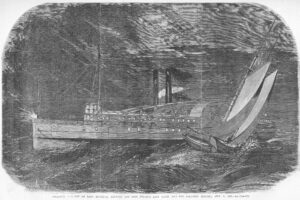
A depiction of the Augusta ramming the Lady Elgin.
A gale arose in the wee hours, but the Lady Elgin forged on. At about 2:30 a.m. the vessel was rammed on the port side by a schooner, the Augusta of Oswego. Believing it to be far more damaged than the Lady Elgin, the Augusta’s captain left the area and set out for Chicago.
But the hole in the Lady Elgin’s port side became more problematic as the vessel began to sink below the water line. The captain ordered the cattle and cargo to be thrown overboard, but that did not help. Within a few minutes the ship broke apart, and most of it sank.
Now, the majority of the passengers bobbed in the frigid water amid the wreckage. Some made it to the shore of what was then Port Clinton, Illinois, in lifeboats or on makeshift rafts. Others were rescued after dawn. Close to one hundred people managed to survive.
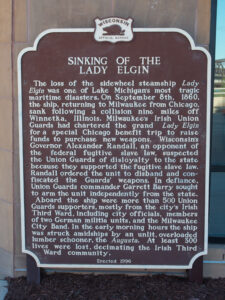
Wisconsin historical marker for the Lady Elgin.
Approximately 300 people from the PS Lady Elgin perished on the morning of September 8th, 1860, by far the greatest loss of life from a single incident on the Great Lakes.
Years later, a Great Lakes historian would call the disaster, “One of greatest marine horrors on record.”